

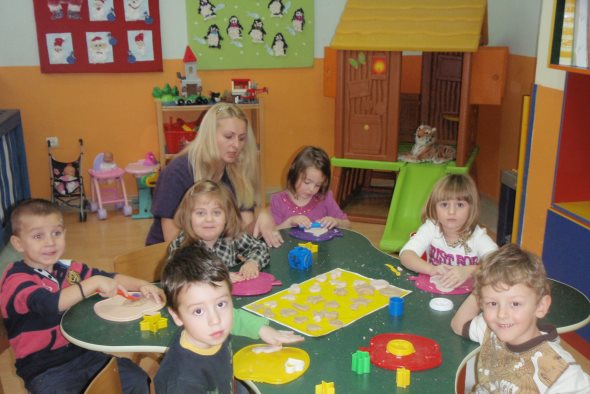
Our main postulates equal the basic postulates of working with pre-school children. We primarily focus on respecting a child’s personality. This means giving an opportunity to a child to build his/her own identity, and to be conscious of his/her own abilities. Our educational work is directed on the accomplishment of long-term tasks and those are: emotional stability, independence, curiosity, initiative, and children’s creativity.
Our program is based on a professor Emil Kamenov’s teaching module. This module focuses on the fact that every thematic unit should influence all aspects of children’s development:
Physical development
- Natural types of movement with elements of athletics and walking, running, jumping, climbing, crawling, pulling through, activities with a ball, and basic types of sport
- Exercises focused on particular muscle groups
- Movement games in the backyard
- Perceptive activities: colors, shapes, listening, tactile activities etc.
- Activities for improving hygiene and children’s health
Socio-emotional and inner development
- Activities that are focused on socializing, social behavior, moral development, emotional intelligence and activities that are focused on creating self-respect and optimism
Cognitive development
- Exploring activities: world around us (plants, animals, people), material world
- Logical activities: generalization and classification, nonverbal activities, comparing activities, estimation, measuring, learning about surroundings, geometric shapes, time knowledge, solving problems
- Practical activities
- Learning about traffic
Development of communication and the ability of invention
- Speaking activities: focusing on standard speech, enriching and widening the scope of children’s vocabulary, grammatical speech, verbal communication, monologue speech, speech invention, learning about literature
- Drama activities (nonverbal presentation, gesticulation, mimics, guessing games, sound and voice presentation, learning about drama as the form of art)
- Art activities: drawing, painting, shaping (using natural materials, paper, wastage, elements of arts of crafts), and aesthetical perception
- Musical activities: listening to music, singing, playing instruments, particularly Orff’s musical instruments: tambourines, clappers, xylophones, marimbas, glockenspiels, different sized drums, and recorders. Orff’s approach is based on the rhythm as natural basics of human expression. It includes: imitation, exploration, literacy, and improvisation.
- Dancing activities: dancing improvisation, dancing dramatization, folk dance, and other types of dance appropriate for children
ENGLISH LANGUAGE
Children learn English through music, motion, watching, games, acting, drawing, and through every-day communication in English. We learn English every day and duration of daily English classes depends on children’s age.
Children acquire new vocabulary through listening, repetition, audio-visual aids, and realia, focusing on every-day situations.
Methodology used in teaching English with young learners:
Oral approach - The younger children are, the oral method is longer. This approach is connected with the primary goal of teaching English, and that is communicative competence of a young learner (the ability to use language in every-day situations). This approach spurs independence and better memory in learning, and draws children’s attention. Simulating teacher’s speech is the main basis of acquiring the second language with young learners.
Integrated approach - Depending on the level of learning, the second language is acquired mechanically and cognitively. Until the period of adolescence, children learn language by simulation. Phrases, vocabulary, and phonetic system are acquired by simulation and repetition. On the other hand, older children learn by cognition and explanation of language system.
Multimedia approach - usage of audio-visual aids (TV, CD player etc.) for the purpose of successful learning. This method motivates children to speak.
Illustrative and demonstrative approach - visual learning, by the means of pictures, flashcards, posters, wall charts etc.
Monthly lesson plans are modulated and connected to lesson plans of teachers that teach in Serbian.
SPEAK UP English Language Plan for preschool children:
| September Greetings! Hello teacher! What’s your name? How old are you? Me and my friends My family Colors |
October |
November |
|
December |
January |
February |
|
March |
April |
May |
|
June |
July |
August |
CHILDREN’S SELF-RESPECT
Our nursery offers program for spurring children’s self-respect by me Iboja Gera and me Ljubica Dotlic, for the purpose of developing and preserving basic moral values:
FOSTERING CHILDREN’S SELF-CONFIDENCE
DEVELOPING POSITIVE EMOTIONS AND POSITIVE PICTURE ABOUTONESELF
FOSTERING CHILDREN’S RIGHTS ON PRIVACY
We realize this program through various games and projects. Parents are also included in this program which consists if the following matrices:
FAMILY BOOK OF MEMORIES (includes parent engagement for the purpose of more stable family relations and building up mutual respect within a family)
PERSONAL CASKET (a child’s right to his/her own privacy)
SCROLL OF CHILDREN’S RIGHTS (a child’s right to preserve his/her own individuality and identity)
PREVENTIVE HEALTH CARE PROGRAM
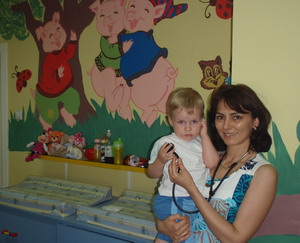
In correlation with Health Centre in Novi Sad our nursing program includes a two-month visit of specialist pediatrician dr Galina Gavanski. Our aim is to prevent possible contagious diseases to develop and spread. Children already got used to Galina and they love her.